
Chiang Mai Holidays

Sales Line - Call now to book
0330 088 8899Open: 8am - 11pm, 7 days a week
Customer Support: 0203 340 0930
Open: 8am - 10pm, 7 days a week
Based on 26,000+ reviews on Trustpilot & 15,000+ reviews on Feefo
Price Match Promise
Secure Trust Protection
Low Deposit
24/7 Support
Trusted for over 30 years
Monthly instalments
Tailored experience
In the mystical north-west of Thailand, the visually striking city of Chiang Mai has all of the cultural advantages of Bangkok without the disadvantages of traffic jams and air pollution. With over 300 temples to explore, a number of elephant sanctuaries to visit, awe-inspiring scenery and mouth-watering cuisine on every corner of every street, this city is an extremely popular choice for tourists wishing to experience the rich culture on offer here.
Combining a stay in Chiang Mai with Bangkok or one of the many beach resorts in Thailand is a very easy and effective way of experiencing the city, the culture and those glorious beaches all in one holiday. Reached either by an overnight bus (which can be quite inexpensive but not the most comfortable) or a short regular flight from Bangkok, Chiang Mai is very accessible.
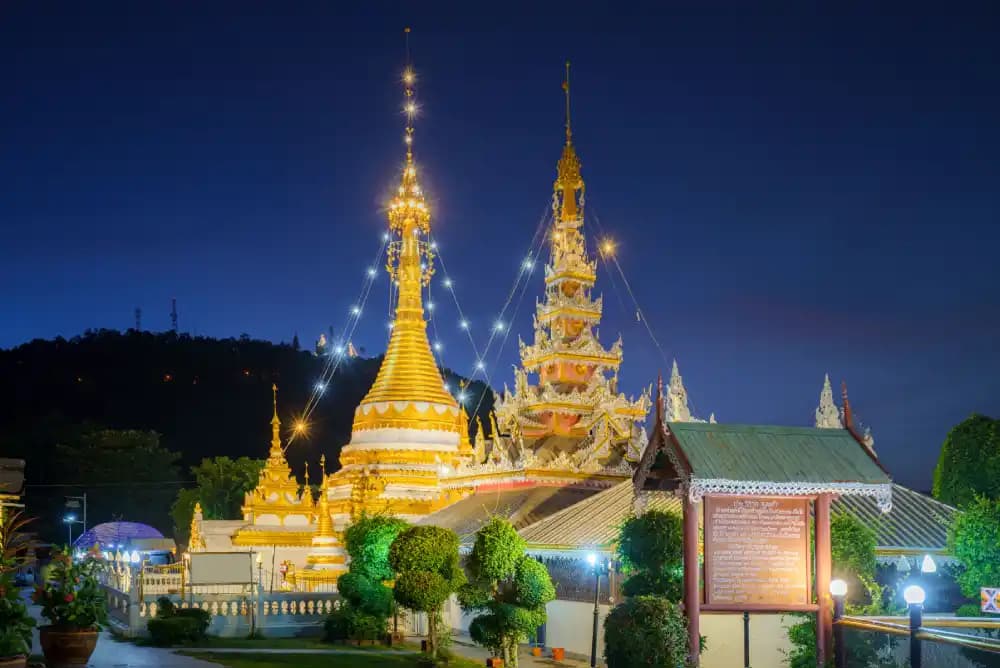
A visit to this city would not be complete without experiencing at least one or two of the magnificent temple complexes here, either independently or as part of an organized tour – the latter whilst sometimes having its downpoints, is often the best way of learning about the importance of these majestic structures. Alongside the famous night market, endless tuk-tuk tours of the city and delectable cuisine, visitors also take up the chance to trek the mountainous area around Mae Taeng. Here the villages of Lahu, Karen and Hmong can be found and there is the chance to try a rafting experience along the beautiful Mae Taeng River.
How long you choose to stay here is up to you, but one thing is for sure, you will never get bored!

Essential Information: When you go and what you'll need
(Avg. monthly °C)
Songthaews, which are generally converted pickup trucks with two benches in the back, are a common mode of transport for locals in Chiang Mai, but possibly not for the faint-hearted tourist! Other means of transport include motorbikes and bicycles as well as tuk-tuks and taxis – the latter being the easiest and most cost-effective way of navigating the city.
For more questions, see our FAQs
(Avg. monthly °C)
Songthaews, which are generally converted pickup trucks with two benches in the back, are a common mode of transport for locals in Chiang Mai, but possibly not for the faint-hearted tourist! Other means of transport include motorbikes and bicycles as well as tuk-tuks and taxis – the latter being the easiest and most cost-effective way of navigating the city.
For more questions, see our FAQs
(Avg. monthly °C)
(Avg. monthly mm)
Songthaews, which are generally converted pickup trucks with two benches in the back, are a common mode of transport for locals in Chiang Mai, but possibly not for the faint-hearted tourist! Other means of transport include motorbikes and bicycles as well as tuk-tuks and taxis – the latter being the easiest and most cost-effective way of navigating the city.
For more questions, see our FAQs

Acting as a retirement home for elephants, many of whom have worked in the logging or tourist industry, this ethical sanctuary allows the careful interaction between visitors and these magnificent creatures. You won’t find any elephants kicking footballs here and elephant back rides are not permitted either. The sanctuary does a great job of promoting responsible tourism by allowing tourists to get up close and personal without exploiting the animals and interfering too much with their natural behaviours.

There are so many temples (Wats) and complexes to explore, from the visually impressive Wat Phra Singh, the huge seated Buddha at Wat Phra That Doi Kham to the most frequently visited Wat Doi Suthep; you simply can’t stay in Chiang Mai without visiting at least one of these impressive structures. If you only manage one, then it’s got to be Wat Doi Suthep. Reached by a winding mountain road followed by a 309-step walk to reach the top, it is not for the faint hearted. But the experience at the top, from the commanding views of the city below to the 600-year old golden Chedi is worth every bit of effort.